At 00:08 there is a low angle focused on Erik this suggests that he has a great deal of power at this moment, however, this is undercut by the fact that he is pinned against the wall and as such it suggests that he has power (as we now to control metal) but doesn't believe he can use it against Shaw. This is further supported by the fact that Erik's job in this scene is to take the helmet off shaw not hurt him.
At 01:03, the wide shot presents Erik and Shaw on a level playing ground, as well as at eye level with the audience, now that Shaw is controlled by Charles and therefore cannot absorb the energy of any attacks sent at him.
The Focus on Erik at 01;42 shows that he now has the upper hand as well as suggesting that he holds all the power in the scene including the corresponding scene in the jet with Charles.
The Pull Focus from the Coin to Erik, shows how despite having grown up, his life is still very much centred with proving himself and being able to do other things than large shows of power, it also shows the influence of the past on his actions suggesting that even if the coin is out of focus it still plays a large role in Erik's decisions. Large shows of power are common with the character as he routinely uses them to advance the plot and change the outcome of a situation, however now he is going to do something precise and delicate instead of using brute strength which is shown by bringing the coin into the scene and changing the focus from the precision that the coin represents the power and control the close-up shows Erik as having as it is seemingly all about him. This can also be seen through his choice to ignore Charles and therefore focus on his priorities over the correct decision.
From 02:04 to 02:41 Charles is positioned in the same place on the frame as Shaw, this shows their mental connection and further emphasises the pain and betrayal Charles feels at Erik's behaviour. This is further emphasised with the occasional cuts of Erik's face.
The Aerial shot of the coin, covered in blood, falling at the end of the clip shows how Erik's past has played out in the present, that his revenge has caused his past to be bloodstained.
Showing posts with label Summer Homework. Show all posts
Showing posts with label Summer Homework. Show all posts
Friday, 22 September 2017

Tuesday, 5 September 2017
Dolly Shot
 A dolly is a cart which travels along tracks. The camera is mounted on the dolly and records the shot as it moves. Dolly shots have a number of applications and can provide very dramatic footage.
In many circles,
a dolly shot is also known as a tracking shot or trucking shot. However, some professionals prefer the more rigid terminology which defines dolly as the in-and-out movement (i.e. closer/further away from the subject), while tracking means side-to-side movement.
They're used by directors to establish other shots i.e. tracking shots of a location in the production.
Monday, 4 September 2017
Handheld
 Hand-held camera or hand-held shooting is a filmmaking and video production technique in which a camera is held in the camera operator's hands as opposed to being mounted on a tripod or other base. Hand-held cameras are used because they are conveniently sized for travel and because they allow greater freedom of motion during filming.Hand-held camera shots often result in an image that is perceptibly shakier than that of a tripod-mounted camera. Purposeful use of this technique is called shaky camera and can be heightened by the camera operator during filming, or artificially simulated in post-production. Shaky Camera is used primarily by a director in horror or action movies as it adds to the intensity of scenes such as chase scenes or fight scenes.
Whip Pan
A whip pan is a type of pan shot in which the camera pans so quickly that the picture blurs into indistinct streaks. It is commonly used as a transition between shots and can indicate the passage of time or a frenetic pace of action, this makes it a good shot for a director to use as it blurs the reality allowing them to perform a time skip with little to no repercussions on the audience's understanding.
Zooming In and Out
 A zoom is technically not a camera move as it does not require the camera itself to move at all. Zooming means altering the focal length of the lens to give the illusion of moving closer to or further away from the action.
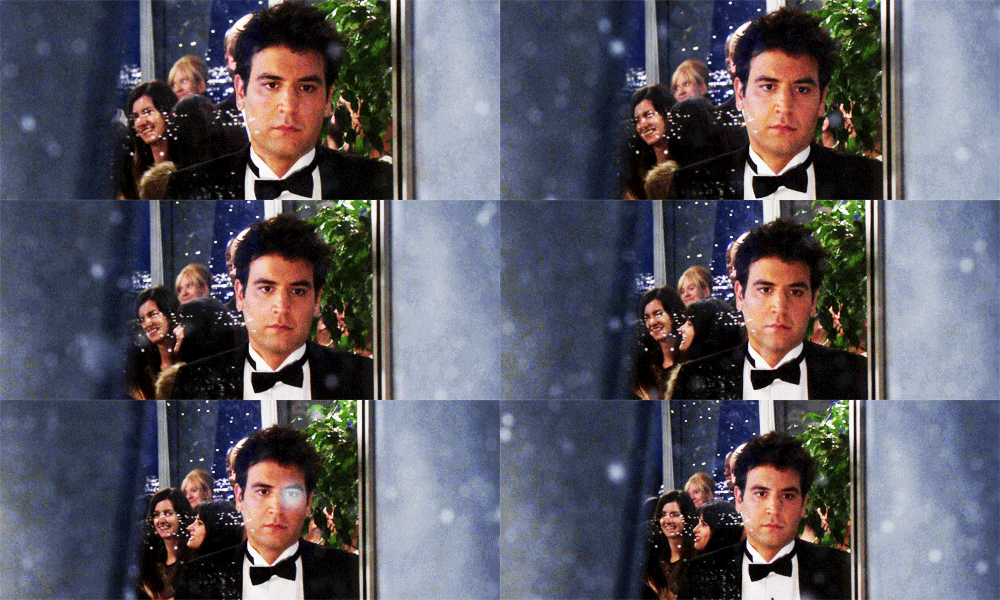 The effect is not quite the same though. Zooming is effectively magnifying a part of the image while moving the camera creates a difference in perspective — background objects appear to change in relation to foreground objects. This is sometimes used for creative effect in the dolly zoom.
A director may use this as a way to encourage a focus on a subject (zoom in) or to discourage said focus (zoom out).
Aerial Camera Movement
 An exciting variation of a crane shot, usually taken from a helicopter. This is often used at the beginning of a film, in order to establish setting and movement. A helicopter is like a particularly flexible sort of crane - it can go anywhere, keep up with anything, move in and out of a scene, and convey real drama and exhilaration — so long as you don't need to get too close to your actors or use location sound with the shots.
Crane Camera Shot
Pull Focus
 The focus pull is a creative camera technique in which you change focus during a shot. Usually, this means adjusting the focus from one subject to another.
A director may use a Focus Pull as it is useful for directing the viewer's attention. For example, if there are two people in shot but only one is in focus, that person is the subject of attention. If the focus changes to the other person, they become the subject. This is often used in drama dialogues — the focus shifts backwards and forwards between the people speaking. A slightly more subtle trick is to focus on a person speaking then pull focus to another person's silent reaction.
Tilt Movement
 A tilt is a vertical camera movement in which the camera points up or down from a stationary location. For example, if you mount a camera on your shoulder and nod it up and down, you are tilting the camera.
Tilting is less common than panning because that's the way humans work — we look left and right more often than we look up and down.
The tilt should not be confused with the Dutch Tilt which means a deliberately slanted camera angle.
A director may choose to use a tilting movement to give the audience the full vision of an imposing or attractive character, usually starting at the shoes and rising to the character's head. This is usually done with a Point of View Shot.
Tracking Movement
 The term tracking shot is widely considered to be synonymous with dolly shot; that is, a shot in which the camera is mounted on a cart which travels along tracks. However there are a few variations of both definitions. Tracking is often more narrowly defined as movement parallel to the action, or at least at a constant distance (e.g. the camera which travels alongside the race track in track & field events). Dollying is often defined as moving closer to or further away from the action. Some definitions specify that tracking shots use physical tracks, others consider tracking to include hand-held walking shots, Steadicam shots, etc.
A director may use this movement to keep the audience engaged as they are at a constant distance from the action on screen.
Pan Camera Movement
 A pan is a horizontal camera movement in which the camera moves left and right about a central axis. This is a swivelling movement, i.e. mounted in a fixed location on a tripod or shoulder, rather than a dolly-like movement in which the entire mounting system moves.
A director may use this to emphasise a point to the audience, in this case that the Avengers have truly assembled for the first time to work as a team.
Low Angle

This shows the subject from below. As such a director may use this shot to give the audience the impression that the subject is being more powerful or dominant.
High Angle Shot
 A high angle shows the subject from above, i.e. the camera is angled down towards the subject. A director would use this as this has the effect of diminishing the subject, making them appear less powerful, less significant or even submissive.
Crane Shot

Aerial Shot
A shot taken from an airborne device, generally while moving. A director may use this shot to establish a new and perhaps exotic location.
Bird's Eye View


Worm's Eye View

A worm's-eye view is a view of an object from below, as though the observer were a worm; the opposite of a bird's eye view. A director may use it as it can be used to look up to something to make an object look tall, strong, and mighty while the viewer feels child-like or powerless.
Point Of View Shot

Extreme Long Shot

In the Extreme Long Shot, the view is so far from the subject that s/he isn't even visible. The point of this shot is to show the subject's surroundings.

A director may use it as an "establishing shot" - the first shot of a new scene, designed to show the audience where the action is taking place. It is also useful in scenes where the action is very spread out. For example, in a war movie an extreme wide shot can show the scale of the action.
Long Shot
 In the long shot, the subject takes up the full frame. In this case, Thor's feet are almost at the bottom of frame and his head is almost at the top. Obviously the subject doesn't take up the whole width and height of the frame, since this is as close as we can get without losing any part of him. The small amount of room above and below the subject can be thought of as safety room — you don't want to be cutting the top of the head off. It would also look uncomfortable if his feet and head were exactly at the top and bottom of frame.
The directors would use this shot to give the audience a full sense of the subject's body language as well as what could be causing their visible emotions.

Subscribe to:
Posts (Atom)